Publised on Aug 10, 2025
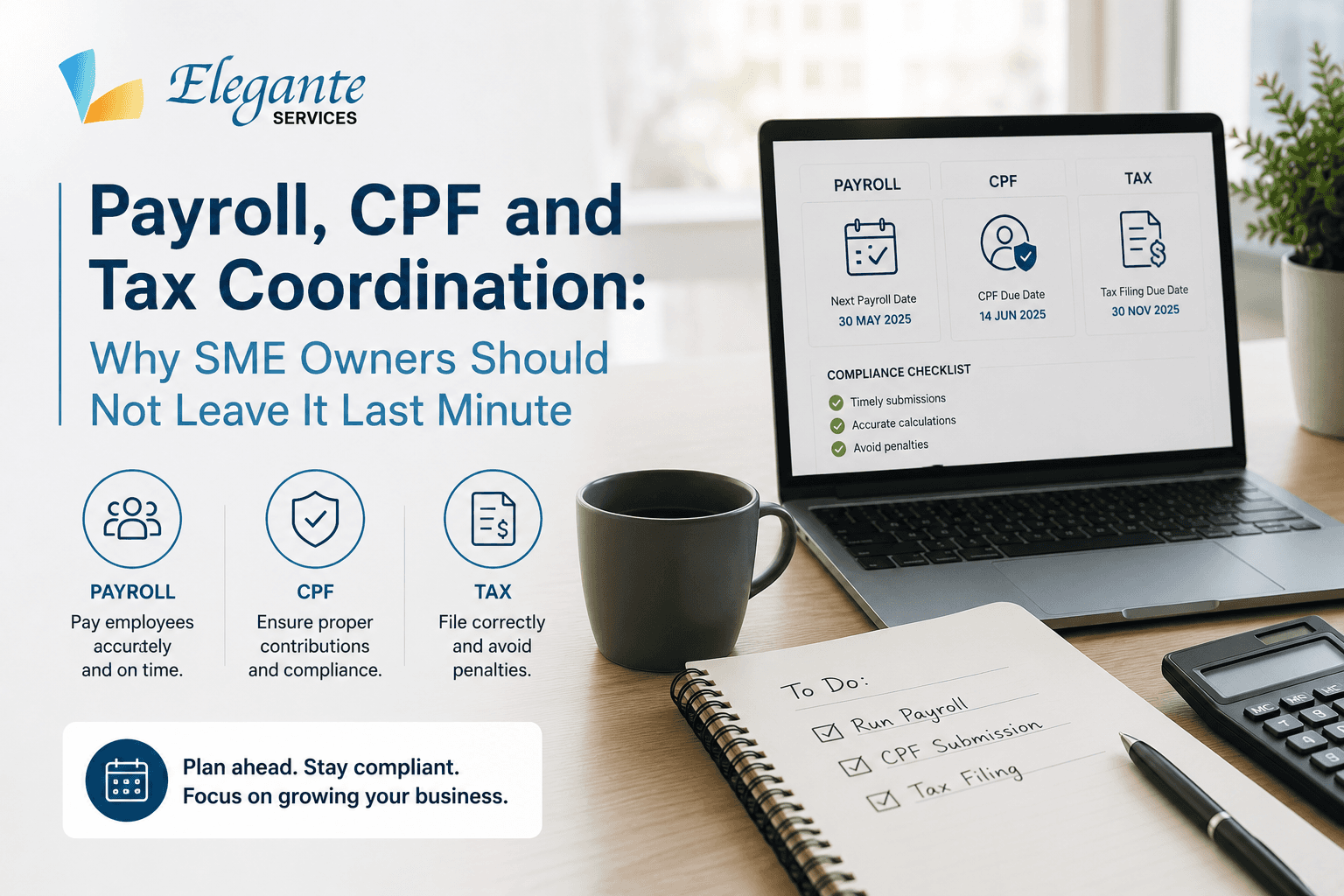
Payroll, CPF and Tax Coordination: Why SME Owners Should Not Leave It Last Minute

Hannah Poh
Payroll, CPF and Tax Coordination: Why SME Owners Should Not Leave It Last Minute
Running a business in Singapore means managing more than sales, customers and daily operations.
For companies with employees, payroll, CPF contributions, accounting records and tax filing preparation are all connected. If one area is not properly managed, it can affect the others.
Many SME owners only start organising payroll and tax records when a deadline is near. By then, missing documents, outdated spreadsheets and unclear salary records can create unnecessary stress.
CPF Board states that CPF contributions are due on the last day of the calendar month, and enforcement action may be taken if employers fail to pay by the 14th of the following month. Late payment interest may also apply.
For business owners, the practical message is simple: payroll and CPF should be managed every month, not only at year end.
Elegante can support business owners with payroll and CPF coordination, accounting services and corporate tax filing coordination.
Why Payroll, CPF and Tax Are Connected
Payroll is not just about paying salary.
Payroll records affect several parts of company administration, including:
CPF contributions
Accounting entries
Staff cost records
Corporate tax preparation
Financial statements
Cash flow planning
Budgeting and manpower cost review
If payroll records are incomplete, the company may struggle to prepare proper accounts.
If accounts are not updated, corporate tax filing becomes more difficult.
If CPF submissions are delayed or inaccurate, the company may need to spend time correcting past records.
This is why SME owners should treat payroll, CPF and tax coordination as one connected process instead of three separate tasks.
For companies that want a more organised process, business administration support can help keep recurring obligations and records better managed.
CPF Contributions Should Be Reviewed Monthly
CPF contributions are a recurring employer responsibility.
CPF Board states that the due date for CPF contributions is the last day of the calendar month, and enforcement action may be taken if payment is not made by the 14th of the following month.
This means employers should not wait until the end of the year to review CPF matters.
Every month, employers should check:
Employee salary records
CPF contribution calculations
Employer CPF contributions
Employee CPF deductions
Bonuses, allowances and additional wage treatment
CPF payment status
Payroll reports
If your company uses manual spreadsheets, it is especially important to check calculations carefully.
A small monthly error can become a bigger issue if repeated over many months.
Elegante can assist with payroll coordination for Singapore employers so that payroll-related records are better organised.
Corporate Tax Filing Depends on Good Records
Corporate tax filing is easier when accounting records are updated throughout the year.
IRAS states that all companies must file their YA 2026 Corporate Income Tax Return by 30 November 2026, including companies that did not carry on business or incurred a loss in financial year 2025.
To prepare for corporate tax filing, companies usually need:
Profit and loss statement
Balance sheet
Bank statements
Sales records
Expense records
Payroll records
CPF records
Director remuneration records
Tax computation
Supporting documents
If payroll and CPF records are not organised, tax filing preparation may become slower and more difficult.
This is why proper accounting services in Singapore can help SMEs avoid last-minute problems during tax season.
ACRA Filing May Also Depend on Updated Accounts
Payroll and tax preparation are also linked to broader company compliance.
ACRA states that companies in Singapore must file annual returns on time, and late annual return filing may result in penalties of up to $600. The filing deadline depends on the company type and financial year end.
Annual return filing is separate from corporate tax filing, but both may depend on having updated company records and accounting information.
If the company’s accounts are not ready, the business owner may face pressure across multiple deadlines.
This is why company owners should not treat annual return filing, payroll and tax preparation as unrelated tasks.
Elegante can support business owners with corporate secretarial services in Singapore and annual compliance reminders.
Why Last-Minute Coordination Creates Problems
Leaving payroll, CPF and tax coordination to the last minute can create several problems.
Common issues include:
Missing payslips or salary records
CPF records not matching payroll records
Bonuses or allowances not recorded clearly
Bank transactions not reconciled
Director payments not properly classified
Employee expense claims not documented
Receipts and invoices missing
Tax filing preparation delayed
Annual return filing affected
Cash flow pressure near tax payment deadlines
For many SMEs, the problem is not that the business owner is careless. The issue is that there is no monthly system.
A proper process helps reduce mistakes before they accumulate.
Payroll Planning for Manpower-Heavy Businesses
Payroll and CPF coordination is especially important for manpower-heavy businesses.
This includes:
Construction companies
Renovation firms
Cleaning companies
F&B businesses
Retail businesses
Logistics companies
Service providers
Project-based companies
For example, builders, renovation firms and a landed house contractor in Singapore may need to review manpower cost together with project budgets, supplier payments, subcontractor costs and progress claims.
In project-based businesses, labour cost can directly affect project profitability.
If payroll records are not accurate, business owners may not fully understand whether a project is profitable.
Good payroll and accounting records help owners review:
Staff cost by project
Overtime cost
CPF cost
Subcontractor cost
Project margin
Cash flow requirements
Future manpower planning
For construction-related SMEs, payroll is not just an HR matter. It is part of project cost control.
Payroll Records and Employee-Created Business Assets
Payroll records deal with employee payments, but employers should also think about the value created by employees.
Some employees may be involved in:
Designing logos
Creating marketing content
Writing website copy
Producing social media materials
Developing product names
Creating software or digital assets
Supporting brand campaigns
For growing SMEs, these assets may become part of the company’s brand identity.
Business owners should therefore review whether employment arrangements and business documentation properly address ownership of work created for the company.
If the company is investing in a name, logo, website or brand identity, it may also be worth considering trademark registration in Singapore to protect the business brand.
This is not a payroll filing matter, but it is part of wider business housekeeping.
A company should not only pay employees correctly. It should also protect the value created by the business.
Monthly Checklist for SME Owners
Instead of waiting until year end, business owners can use a simple monthly checklist.
Each month, review:
Employee salary records
CPF contribution calculations
CPF payment status
Payslips and payroll reports
Staff claims and reimbursements
Sales invoices
Supplier invoices
Expense receipts
Bank transactions
Director and shareholder transactions
Cash flow position
Accounting records
This monthly habit makes year-end tax preparation much easier.
It also helps owners spot business issues earlier.
Quarterly Checklist for Better Tax Preparation
Every quarter, SMEs can also review:
Profit and loss position
Balance sheet items
Outstanding receivables
Outstanding payables
Payroll cost trend
CPF records
GST position, if applicable
ECI preparation, if relevant
Budget versus actual cost
Cash flow forecast
This helps business owners avoid surprises near tax filing season.
For growing SMEs, regular review is often more useful than waiting for year-end accounts.
Common Mistakes SME Owners Should Avoid
SME owners should avoid these common mistakes:
Only preparing payroll records at year end
Paying CPF late
Using outdated CPF rates
Mixing personal and business expenses
Not keeping payslips
Not documenting bonuses or allowances clearly
Losing receipts
Not reconciling bank statements
Treating tax filing as a last-minute task
Assuming inactive companies have no filing obligations
Forgetting annual return filing deadlines
Many of these issues can be avoided with proper business administration support and a simple recurring compliance system.
Simple Year-End Preparation Checklist
Before the end of the financial year, business owners should check:
Are payroll records complete?
Are CPF contributions submitted correctly?
Are bank statements available?
Are sales invoices organised?
Are supplier invoices recorded?
Are expense receipts saved?
Are director payments properly classified?
Are employee claims documented?
Are accounting records updated?
Is corporate tax filing preparation planned?
Is annual return filing timeline clear?
If these items are prepared early, the company can reduce filing stress significantly.
Related Guides for Singapore Business Owners
Payroll, CPF and tax coordination should be viewed together with wider company compliance.
You may also find these guides useful:
Business owners may also wish to review wider business protection and sector-specific planning. Growing SMEs can consider trademark registration in Singapore to protect their brand identity, while manpower-heavy project businesses such as builders, renovation firms and a landed house contractor in Singapore should maintain proper payroll, project cost and cash flow records.
How Elegante Can Help
Elegante supports SMEs with business administration and compliance coordination.
Our services may include:
Instead of handling payroll, CPF and tax only when deadlines are near, business owners can work with Elegante to keep recurring records and obligations better organised throughout the year.
Contact Elegante Services to discuss your company’s payroll, accounting and compliance support needs.
Disclaimer
This article is for general information only and should not be treated as legal, accounting, tax, payroll or financial advice. Business owners should refer to CPF Board, IRAS, ACRA or consult a qualified professional for advice specific to their company.