Publised on Jul 25, 2025
GST InvoiceNow in Singapore: What GST-Registered Businesses Should Prepare For

Hannah Poh
GST InvoiceNow in Singapore: What GST-Registered Businesses Should Prepare For
Singapore is moving towards greater digitalisation of tax administration, and GST InvoiceNow is one of the key changes that GST-registered businesses should understand.
For many SMEs, invoicing is still handled through spreadsheets, PDF invoices, accounting software, manual email records or a mix of different systems. As GST InvoiceNow is progressively implemented, businesses should review whether their invoicing and accounting processes are ready.
IRAS states that GST-registered businesses will be required to submit invoice data to IRAS via the InvoiceNow network, and this mandatory participation will be implemented progressively in phases.
For business owners, this is not just a tax update. It is also a reminder to keep accounting records, invoicing workflows and GST-related documents properly organised.
Elegante can support business owners with accounting services in Singapore, corporate tax filing coordination and business administration support
What Is GST InvoiceNow?
GST InvoiceNow is part of Singapore’s e-invoicing and tax digitalisation direction.
InvoiceNow is Singapore’s nationwide e-invoicing network based on the Peppol standard. According to the IRAS e-Tax Guide, InvoiceNow was launched in 2019 and is managed by IMDA, which is Singapore’s Peppol Authority.
Under the GST InvoiceNow requirement, GST-registered businesses will progressively be required to transmit invoice data to IRAS through the InvoiceNow network.
This does not mean businesses simply email invoices to IRAS manually. Instead, invoice data is transmitted through InvoiceNow-ready accounting or finance solutions.
For SMEs, this means accounting software, invoicing workflow and GST records may need to be reviewed before the relevant implementation deadline.
Who Must Comply and When?
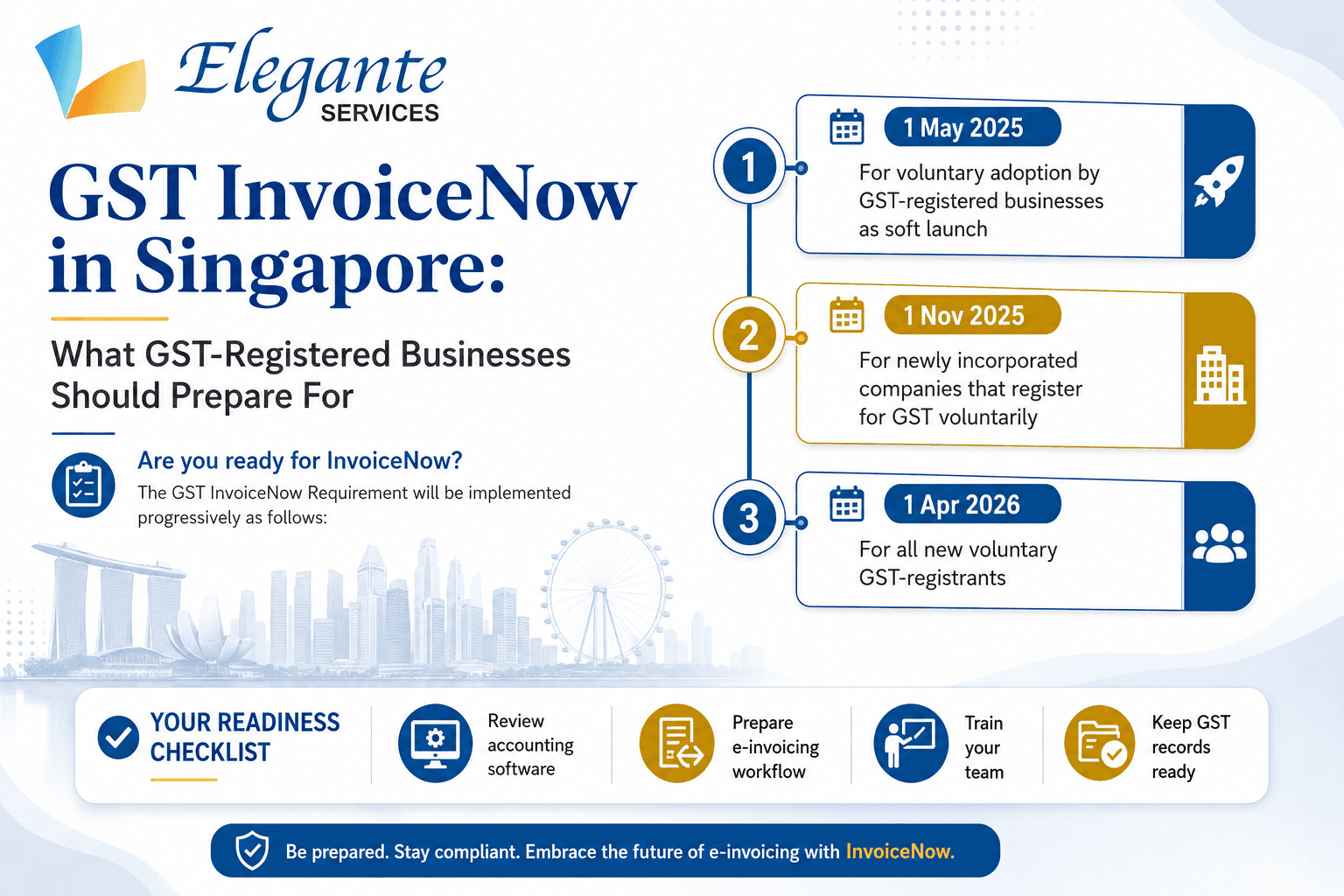
IRAS has set out a phased implementation timeline for GST InvoiceNow.
According to IRAS, mandatory participation will apply progressively as follows:
Implementation Date | Who It Applies To |
|---|---|
1 November 2025 | Companies that register for GST voluntarily within 6 months of incorporation |
1 April 2026 | All new voluntary GST registrants, regardless of incorporation date or business structure |
1 April 2028 | All new compulsory GST registrants and existing GST-registered businesses with total annual supplies up to S$200,000 |
1 April 2029 | Existing GST-registered businesses with total annual supplies up to S$1,000,000 |
1 April 2030 | Existing GST-registered businesses with total annual supplies up to S$4,000,000 |
1 April 2031 | Existing GST-registered businesses with total annual supplies above S$4,000,000 |
IRAS has also stated that existing GST-registered businesses registered before 2026 will be informed of their respective mandatory implementation date by mid-2026.
Business owners should not wait until the deadline is near. Early preparation gives companies more time to review accounting software, invoice formats, GST records and internal workflows.
Which Businesses Are Excluded?
Not every business is included in the GST InvoiceNow requirement.
IRAS states that the following groups are excluded from the GST InvoiceNow requirement:
Overseas entities, including Overseas Vendors liable to register for GST under the Overseas Vendor Registration regime
Businesses liable to register for GST wholly due to the Reverse Charge regime
If your business is unsure whether it falls within the requirement, it should refer to IRAS guidance or seek professional advice.
What Does This Mean for SMEs?
For SMEs, GST InvoiceNow may affect how invoices are created, recorded and transmitted.
Business owners may need to review:
Whether their accounting software is InvoiceNow-ready
Whether invoice data is captured accurately
Whether customer and supplier information is properly recorded
Whether GST treatment is correctly applied
Whether staff understand the invoicing process
Whether invoice records match GST return records
Whether business documents are organised for future checks
This is especially important for businesses that still rely heavily on spreadsheets, manual invoice templates or unstructured folders.
A move towards GST InvoiceNow is also a move towards cleaner digital accounting processes.
Elegante can help business owners organise bookkeeping and accounting coordination so that invoicing and GST records are easier to manage.
When Must Invoice Data Be Transmitted?
IRAS states that invoice data must be transmitted by the earlier of the GST return filing date or the filing due date of the relevant GST return.
This means invoice data submission should be connected to your GST return preparation process.
Businesses should not treat invoice transmission as a separate last-minute task.
Instead, invoice data should be properly recorded throughout the GST accounting period so that GST filing and invoice data submission can be managed smoothly.
For SMEs, this reinforces the importance of timely monthly or quarterly accounting updates.
GST InvoiceNow Does Not Remove Record-Keeping Duties
GST InvoiceNow does not remove existing record-keeping requirements.
IRAS states that businesses must continue to comply with the prevailing record-keeping requirements, and adoption of GST InvoiceNow does not remove the need to comply with mandatory record-keeping requirements for GST-registered businesses.
This is an important point.
Even if invoice data is transmitted electronically, businesses must still maintain proper records.
These may include:
Tax invoices
Customer invoices
Supplier invoices
Credit notes
Debit notes
GST return workings
Payment records
Bank statements
Contracts and supporting documents
Accounting ledgers
For business owners, GST InvoiceNow should be seen as part of better accounting discipline, not a replacement for proper bookkeeping.
Preparing Your Accounting System
One of the most important preparation steps is reviewing your accounting or finance system.
IRAS states that InvoiceNow-ready solutions are accounting and finance software that allow transmission of invoices via the InvoiceNow network.
Businesses using off-the-shelf accounting or finance solutions should check whether their preferred solution is listed as an accredited InvoiceNow-ready solution provider.
SMEs should review:
Current accounting software
Invoice generation process
Customer master data
Supplier master data
GST codes
Invoice approval workflow
Staff access rights
Record storage process
Data accuracy before submission
If your business still uses manual invoice templates, now is a good time to review whether a more structured accounting system is needed.
GST InvoiceNow and Project-Based Businesses
GST InvoiceNow may be especially relevant for project-based businesses because invoices and claims can be more complex.
This includes:
Construction companies
Renovation firms
Interior design companies
Engineering consultants
Contractors
Property-related service providers
Project management businesses
For example, builders, renovation firms and a landed house contractor in Singapore may issue invoices linked to project milestones, progress claims, variation orders, retention sums, supplier costs and subcontractor coordination.
If invoice records are not properly structured, GST reporting may become more difficult.
Project-based SMEs should pay attention to:
Progress claim invoices
Variation order invoices
Credit notes
Retention sums
Supplier GST invoices
Subcontractor invoices
Project cost tracking
Customer payment schedules
GST output and input tax records
For construction and renovation businesses, GST InvoiceNow readiness is not only an accounting issue. It may also affect project administration and cash flow tracking.
GST InvoiceNow and Business Digitalisation
GST InvoiceNow is also part of a broader business digitalisation shift.
When businesses move from manual invoicing to structured e-invoicing, they may improve:
Invoice accuracy
Payment tracking
GST record quality
Accounting efficiency
Supplier and customer coordination
Audit readiness
Cash flow visibility
However, digitalisation also means that businesses should pay closer attention to their digital assets and business identity.
If your company is investing in software, branding, website content, marketing materials or a stronger digital presence, you may also wish to review whether your brand name and logo are properly protected through trademark registration in Singapore
A business that is becoming more digital should not only improve its accounting systems. It should also protect the identity and brand value it is building.
Common Mistakes Businesses Should Avoid
Businesses preparing for GST InvoiceNow should avoid these common mistakes:
Waiting until the mandatory deadline is near
Assuming current invoice templates are sufficient
Using outdated accounting software
Not checking whether the software is InvoiceNow-ready
Not training staff on invoice procedures
Mixing GST and non-GST records poorly
Not maintaining proper supporting documents
Treating invoice data transmission as separate from GST filing
Ignoring project-based invoice complexity
Assuming e-invoicing removes record-keeping duties
The best approach is to review current processes early and improve weak areas before the requirement applies to your business.
Simple GST InvoiceNow Preparation Checklist
Business owners can use this checklist:
Check whether your business is GST-registered
Confirm whether GST InvoiceNow applies to your business
Identify your mandatory implementation date
Review whether your accounting software is InvoiceNow-ready
Review invoice data quality
Check customer and supplier records
Review GST coding and tax treatment
Organise invoice approval workflow
Keep proper supporting documents
Train staff involved in invoicing and accounting
Review GST filing process
Seek support early if unsure
Related Guides for Singapore Business Owners
GST InvoiceNow should be viewed together with wider accounting, tax and compliance planning.
You may also find these guides useful:
Business owners may also wish to review wider business protection and sector-specific planning. Growing SMEs can consider trademark registration in Singapore to protect their brand identity, while project-based businesses such as builders, renovation firms and a landed house contractor in Singapore should maintain proper invoice records, project cost records and cash flow planning.
How Elegante Can Help
Elegante supports SMEs with business administration and compliance coordination.
Our services may include:
As Singapore moves towards greater digitalisation of tax administration, business owners should keep their invoicing and accounting records properly organised.
Contact Elegante Services to discuss your accounting and business administration support needs.
Disclaimer
This article is for general information only and should not be treated as legal, accounting, tax, GST, payroll or financial advice. Business owners should refer to IRAS, IMDA, ACRA, CPF Board or consult a qualified professional for advice specific to their company.