Publised on Aug 29, 2025
Changing Your Company Financial Year End in Singapore: What Business Owners Should Know

Hannah Poh
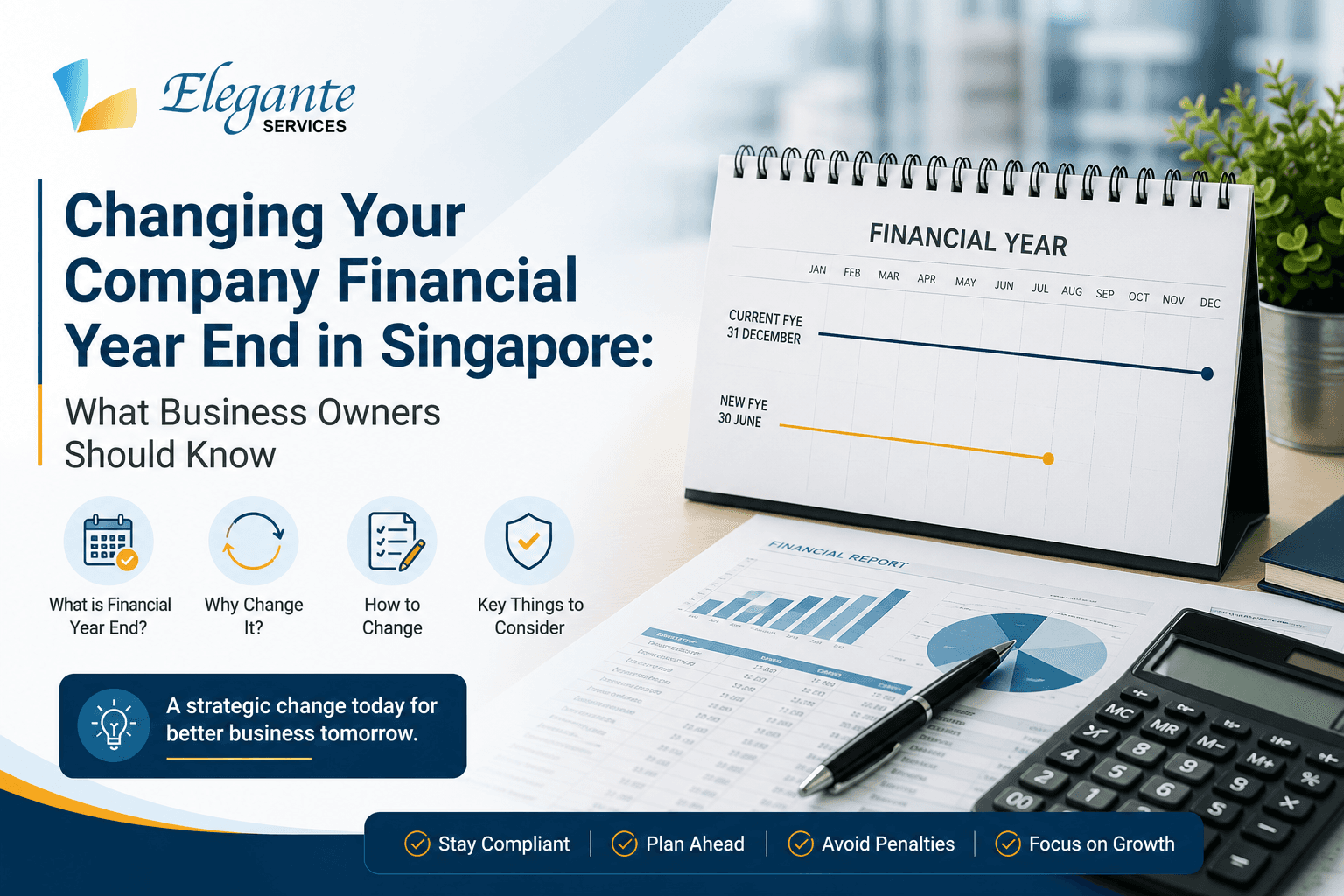
Changing Your Company Financial Year End in Singapore: What Business Owners Should Know
A company’s financial year end, commonly known as FYE, is one of the most important dates in company administration.
It affects when the company prepares its accounts, holds its Annual General Meeting, files its annual return with ACRA and prepares its Corporate Income Tax filing with IRAS.
Many business owners choose a financial year end when incorporating a company, but later realise that another date may be more practical for accounting, tax planning or business operations.
If your company is considering a change of financial year end, it is important to understand the rules before making the change.
ACRA states that companies must notify ACRA if they change their financial year end. You can only change the current or previous financial year, and you cannot change your FYE if you have missed the deadlines for AGM, annual return filing, or sending financial statements.
For business owners who want help managing filing dates and company records, Elegante can support with corporate secretarial services in Singapore.
What Is a Company Financial Year End?
A company’s financial year end is the date on which the company’s accounting period ends.
For example, if your company’s financial year end is 31 December, your accounts usually cover the period ending on 31 December each year.
If your company’s financial year end is 30 June, your accounts usually cover the period ending on 30 June each year.
The financial year end affects several important company matters, including:
Accounting period
Preparation of financial statements
AGM timeline
Annual return filing deadline
ECI filing timeline
Corporate Income Tax Return filing
Business planning and cash flow review
This is why choosing or changing your FYE should not be treated as a minor administrative decision.
Elegante can help business owners organise annual compliance reminders so that key dates are tracked properly.
Why Companies May Want to Change Their Financial Year End
There are several reasons why a company may want to change its financial year end.
Common reasons include:
Aligning the FYE with the group company or parent company
Aligning the FYE with business seasonality
Giving more time to prepare accounts
Better matching revenue and expense cycles
Improving tax and cash flow planning
Aligning with project completion cycles
Reducing year-end administrative pressure
For example, a retail business may prefer a financial year end after its busy festive sales period. A project-based company may prefer a financial year end that aligns better with project billing and cost recognition.
For SMEs, the best FYE is usually one that makes accounting, tax preparation and business review easier.
When Must You Notify ACRA?
If your company changes its financial year end, you must notify ACRA.
ACRA states that a company must notify ACRA when changing its FYE and can only change the current or previous financial year. ACRA also states that a company cannot change its FYE if it has missed the deadlines for AGM, annual return filing, or sending financial statements.
This means timing matters.
If your company has already missed statutory deadlines, changing the FYE may not be available as a simple solution to avoid late filing issues.
Business owners should review the company’s compliance position before making any change.
This is where proper ACRA compliance support can help avoid confusion.
When Is ACRA Approval Required?
Not every change of financial year end requires ACRA’s approval.
However, ACRA approval is required in certain situations.
ACRA states that approval is required if the new financial year will be longer than 18 months, or if the company changed its FYE on or after 31 August 2018 and wants to change it again within five years. If approval is not required, the change will be updated immediately.
This is important because some business owners may assume that they can freely change the FYE whenever they want.
In practice, the company should check:
Whether the new financial year will exceed 18 months
Whether the company has changed its FYE before
Whether the last change was within five years
Whether any filing deadlines have already been missed
Whether ACRA approval is required
Before making a change, it is better to review the company’s compliance history and filing timeline carefully.
Does IRAS Need to Be Notified Separately?
For local companies and branches of foreign companies registered with ACRA, IRAS states that financial year end changes should be updated with ACRA via BizFile+. IRAS will receive the information from ACRA by the following week, and the FYE cannot be updated through myTax Portal.
IRAS also states that if a company changes its name, registered address or financial year end, the change must be filed with ACRA via BizFile+, and IRAS updates its records based on information filed with ACRA on a weekly basis.
This means the ACRA filing is the key step for local companies.
However, business owners should still check that the company’s tax timelines and records are updated correctly after the change.
Elegante can assist with corporate tax filing coordination so that business owners can better manage tax-related follow-up after changing FYE.
How FYE Affects Annual Return Filing
The company’s financial year end affects annual return filing deadlines.
ACRA states that annual return deadlines depend on the company type and financial year end, and companies must file annual returns on time to avoid penalties of up to $600.
This means changing your FYE may also change your annual compliance timeline.
Before changing FYE, business owners should understand how the new date affects:
AGM deadline
Annual return filing deadline
Financial statement preparation
Shareholder approval process, where applicable
Company secretary workflow
A change of FYE should not be viewed in isolation. It affects the company’s broader compliance calendar.
For a wider overview, you may also read our Annual Return Filing in Singapore guide.
How FYE Affects Corporate Tax Filing
A company’s financial year end also affects its tax basis period and filing timelines.
IRAS states that all companies must file their YA 2026 Corporate Income Tax Return by 30 November 2026 at myTax Portal, including companies that did not carry on business or incurred a loss in financial year 2025.
For many companies, Estimated Chargeable Income, or ECI, is also linked to the company’s financial year end.
If the FYE changes, business owners should review:
The company’s accounting period
ECI filing timeline
Corporate tax filing preparation
Accounting records needed for the changed period
Tax computation impact
Cash flow planning
This is where proper accounting services in Singapore can help ensure the company’s records are aligned with the new financial year end.
FYE Planning for Project-Based Businesses
For project-based businesses, choosing the right financial year end can be especially important.
These businesses may have uneven revenue and expenses across the year.
This includes:
Construction companies
Renovation firms
Interior design companies
Engineering firms
Contractors
Project management businesses
Property-related service providers
For example, builders, renovation companies and a landed house contractor in Singapore may need to consider project milestones, progress claims, subcontractor payments, manpower cost, supplier invoices and year-end accounting cut-off.
If the FYE does not match how the business operates, accounting and tax preparation may become more complicated.
Project-based SMEs should review whether their FYE supports clear reporting of:
Project revenue
Project costs
Work-in-progress
Progress claims
Retention sums
Variation orders
Supplier and subcontractor payments
Payroll and CPF costs
A suitable FYE can help business owners better understand project profitability and cash flow.
FYE and Business Growth Planning
Changing your company’s financial year end is usually an administrative and accounting decision.
However, business owners should also use this moment to review wider business planning.
If your company is growing, rebranding, launching new services or preparing for expansion, it may be a good time to review whether your company name, logo and business identity are properly protected.
Many business owners assume that registering a company name with ACRA is the same as protecting the brand. In practice, company registration and trademark protection serve different purposes.
If your brand name or logo is important to the business, you may wish to consider trademark registration in Singapore as part of your broader growth planning.
This is especially relevant for companies investing in:
Branding
Website development
Marketing campaigns
Product or service expansion
Franchise planning
Regional growth
Social media presence
For SMEs, clean company records help the business stay compliant. Brand protection helps protect the value the business is building.
Common Mistakes When Changing Financial Year End
Business owners should avoid these common mistakes:
Changing FYE without checking ACRA rules
Assuming every FYE change is automatically allowed
Changing FYE after missing filing deadlines
Forgetting that ACRA approval may be required
Not reviewing AGM and annual return timelines
Not checking tax filing implications
Not updating accounting records correctly
Not informing the accounting or tax team early
Choosing an FYE that does not match business operations
A change of financial year end should be planned properly, not done only to delay filing deadlines.
Simple Checklist Before Changing Your Company FYE
Before changing your company’s financial year end, review the following:
What is the current FYE?
What is the proposed new FYE?
Is the change for the current or previous financial year?
Has the company missed any AGM, annual return or financial statement deadline?
Will the new financial year be longer than 18 months?
Has the company changed its FYE within the past five years?
Is ACRA approval required?
How will the change affect annual return filing?
How will the change affect tax filing?
Are accounting records ready for the revised period?
Have directors and shareholders been informed, where required?
Related Guides for Singapore Business Owners
Changing financial year end should be reviewed together with wider company compliance and tax planning.
You may also find these guides useful:
Business owners may also wish to review wider business protection and sector-specific planning. Growing SMEs can consider trademark registration in Singapore to protect their brand identity, while project-based businesses such as builders, renovation firms and a landed house contractor in Singapore should maintain proper records for project cost, manpower planning and cash flow.
How Elegante Can Help
Elegante supports SMEs with business administration and compliance coordination.
Our services may include:
Changing a company’s financial year end may affect annual return filing, accounting preparation and tax filing. Elegante can help business owners keep these matters better organised.
Contact Elegante Services to discuss your company’s compliance support needs.
Disclaimer
This article is for general information only and should not be treated as legal, accounting, tax, payroll or financial advice. Business owners should refer to ACRA, IRAS, CPF Board or consult a qualified professional for advice specific to their company.